As a systemic therapist, I can’t ignore the socio-political changes and atmosphere that is weighing on my clients. This is especially true as the populations that I work with are more likely to be both directly and indirectly impacted by such changes. The stress of the larger system reverberates through each of its parts. I would be remiss to ignore the impacts of this stress felt in the family, couple, and individual systems that I work with. I’d like to discuss with you today some of the feelings that many of us are struggling with, particularly how to balance these feelings so that we may use them to care for ourselves, engage with our communities, and push forward together for change.
Distraction and Avoidance
Let’s say I were to ignore the feelings that come up or convince myself that nothing is wrong. To name this – this would be avoidance. Avoidance can sometimes be adaptive in the form of distractions or compartmentalization. It is a common emotional crisis tool. When we are experiencing a great deal of emotional duress and are unable to ground ourselves with other coping skills, avoidance can get us through the moment. We distract ourselves and tuck our feelings away for later when we have the time and energy to confront them.
However, when avoidance becomes a frequent pattern and our answer to all stressors, both mild and intense, it only enables the current status quo to persist. It immobilizes us and resists change. If I were to allow myself to engage with this pattern, what message would it send to my clients? Not making space for these feelings for myself creates uncertainty whether my clients are allowed at all or if I will be safe to discuss such issues with. Or the feelings might come out in other ways that I was unprepared for, potentially detracting from the therapeutic quality.
Fear and Despair
Fear is one of those natural responses that I hope we all create space to discuss with one another. There are a lot of uncertainties and scary possibilities right now. It’s reasonable to be both concerned and scared. These feelings are telling us that we should pay attention, learn more and stay updated and act when appropriate.
There is a point at which fear does become unmanageable, however. If we let fear control us, we can fall prey to media and messages that prey on our fears, making us feel even more extreme. Consuming information with discernment—choosing sources that inform rather than sensationalize—helps us engage meaningfully without spiraling into helplessness and despair. Reaching despair immobilizes us just as avoidance might, believing WHAT IS is hopeless and we have no power to contribute to change.
Contribution and Burnout
Many of us want to see change and contribute to it. As a mental health care professional, I take on a burden to actively be a part of change and growth. The thought is, “I should take on difficult, uncomfortable conversations, the very thing I was trained to do, every single opportunity. I must participate in change.” This is true for me in the therapy room, and it extends to my daily life. There is a pressure to be on the “front-lines” that leads to self-criticism, such as, “I’m not doing enough.”
We must be careful with consistent self-criticisms. Though they may motivate us, when we push ourselves to do more than we can sustainably do, the weight of it all becomes too much. It leads to getting sucked into feelings of being on edge, not being able to relax, or guilt for even routine basic needs and self-care. This mindset can quickly lead to burnout.
The deeper we go in our burnout spiral and the longer we stay on the “front-lines” without reprieve, the more we become overwhelmed by all the issues that are just too big to tackle on our own. Our physical and emotional resources become depleted, leaving us with decreased capacity to operate under the conditions we are trying to change.
Community Support
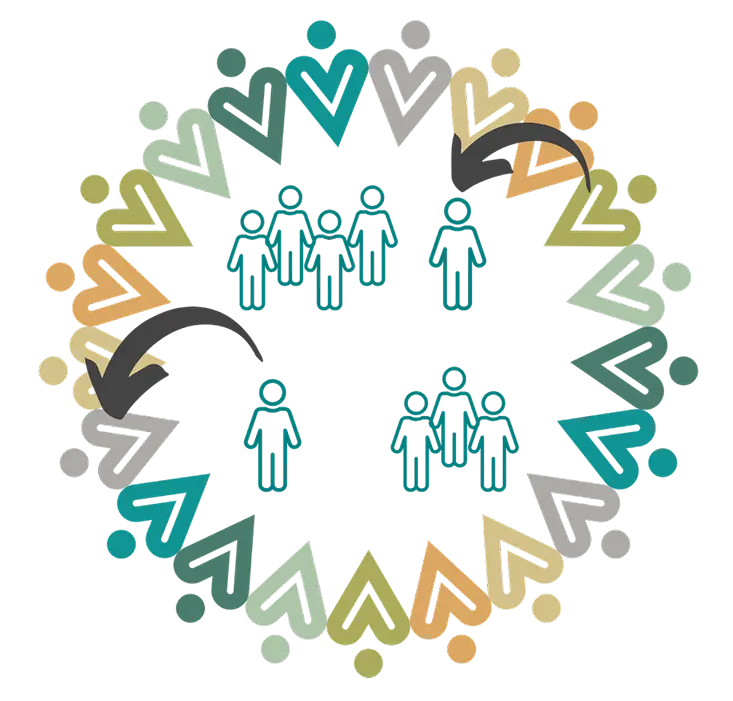
I want to elaborate a little more on what I mean by the “front-lines”. While working with one of my clients, we collaborated to create a visual to more easily discuss this sort of pressure we feel, whether it is coming from an internal place or is influenced by others around us. And what we came up with was to think about a singular community that we are a part of. We know that communities can overlap of course, but to discuss it more simply at first, we use a circle to represent this one community that we are focusing on. We acknowledge the external pressures on this community by larger society. The “front lines” is the outer ring of the circle. It represents the protective parts that interact with elements of larger society (whether that’s policies, laws, etc) or other communities and people. If you are on the “front lines”, you are advocating. You are using your voice. You are gathering and building resources. You are having difficult conversations. And while doing these things, you may be exposing yourself to greater risk of being impacted by outside influences. It is not sustainable to be on the “front lines” forever.
Moving to the inside of the circle and seeking support can be restorative for both you and others. When we feel afraid, we can validate and reassure each other. When we become overwhelmed, we can help each other ground ourselves and motivate each other forward. We can engage in self-care and give others permission to do the same. We show up and engage in safe spaces, and contribute to the safety of those spaces with our mindful presence. Interacting within the community is just as important as being a part of the front lines.
It’s important to remind ourselves that we do stand with others, that we do stand together. We are participating on the front lines of change. And it’s okay to retreat back and welcome the mutual support that community offers. And the only person who can evaluate where you are able to be and when, is you.
Invitation to Reflect
- Are you struggling with any of the emotional experiences described here? Do you feel that you are switching between any of them?
- Using the visual, which part of the circle would you say you are the most? Where are you right now?
- What support would be helpful to you right now? What support can you offer to others?
- If moving to a different spot in the circle would benefit you, what small action can you take today to move in that direction?